Short-termism
The electoral cycle rewards quick wins. Long-term challenges — climate, infrastructure, demographic change — fall outside the window in which a politician's career is judged.
Competent Democracy is a proposal for a political system built around binding, expert-approved manifestos, open-source measurement, and a tribunal that enforces what was promised.
"Many forms of Government have been tried, and will be tried in this world of sin and woe. No one pretends that democracy is perfect or all-wise. Indeed it has been said that democracy is the worst form of Government except for all those other forms that have been tried from time to time…" — Winston ChurchillRead the case
The democratic settlement of the twentieth century delivered freedom and prosperity at unprecedented scale. It is also showing three persistent failures.
The electoral cycle rewards quick wins. Long-term challenges — climate, infrastructure, demographic change — fall outside the window in which a politician's career is judged.
Fragmented parliaments, opaque coalitions, and slow procedures mean that even agreed decisions take years to reach delivery. Citizens watch decisions evaporate between vote and outcome.
Politicians can promise what cannot be delivered, govern through manifestos no one tracks, and face no consequence beyond an election four or five years later. The cost of broken promises falls on the public, not the promiser.
Stand for election on a manifesto of measurable goals; have those goals reviewed by independent expert committees and locked 90 days before polling; have progress scored by an open-source AI run by a separate non-profit; let citizens watch every score in real time; and if you don't deliver — or if you promised what could not be delivered — lose office, and lose the right to hold it again.
People differ — by upbringing, by life experience — and settle into political philosophies: conservative, liberal, socialist, libertarian, environmentalist. Competent Democracy keeps that exactly as it is. It takes no view on which goals a country should pursue. Parties still propose from their own convictions, and voters still choose between them. All that changes is that a goal must be stated clearly enough that anyone can tell, afterwards, whether it happened.
Each part is conventional in some other domain — corporate governance, professional regulation, scientific peer review. The novelty is the assembly.
To stand for election, a party publishes a manifesto of measurable, time-bound, budgeted goals — each reviewed and approved by the relevant expert committee. The manifesto is locked 90 days before election day. After that, goals can only change through a defined Change Management process.
Standing committees of experts — drawn from a single public roster maintained by an independent commission — review every goal before it appears on a ballot. Experts publish their political philosophical views and declarations of interest; they cannot belong to a political party. The design does not pretend expertise is politically neutral — it is partisan-aware but not partisan-controlled.
Progress is scored by purpose-built open-source software. An international non-profit (D2DEV) develops the framework; a national non-profit (D2OPS) operates it on the country's data. Code, parameters, and inputs are public, and scores are appealable.
Track A is collective and political: governments missing their milestones lose office automatically. Track B is individual and adjudicative: an independent prosecutor brings false-promise cases before a specialised Manifesto Tribunal.
Every locked goal, every score, every parameter change, every appeal, every override, every sanctions outcome is published on a single public application. The App is also the channel for electronic voting alongside paper balloting.
Competent Democracy is a small number of named institutions, each with a single role, each holding a check on at least one other. The separations are deliberate: no single coalition should control both the rules of measurement and its operation.
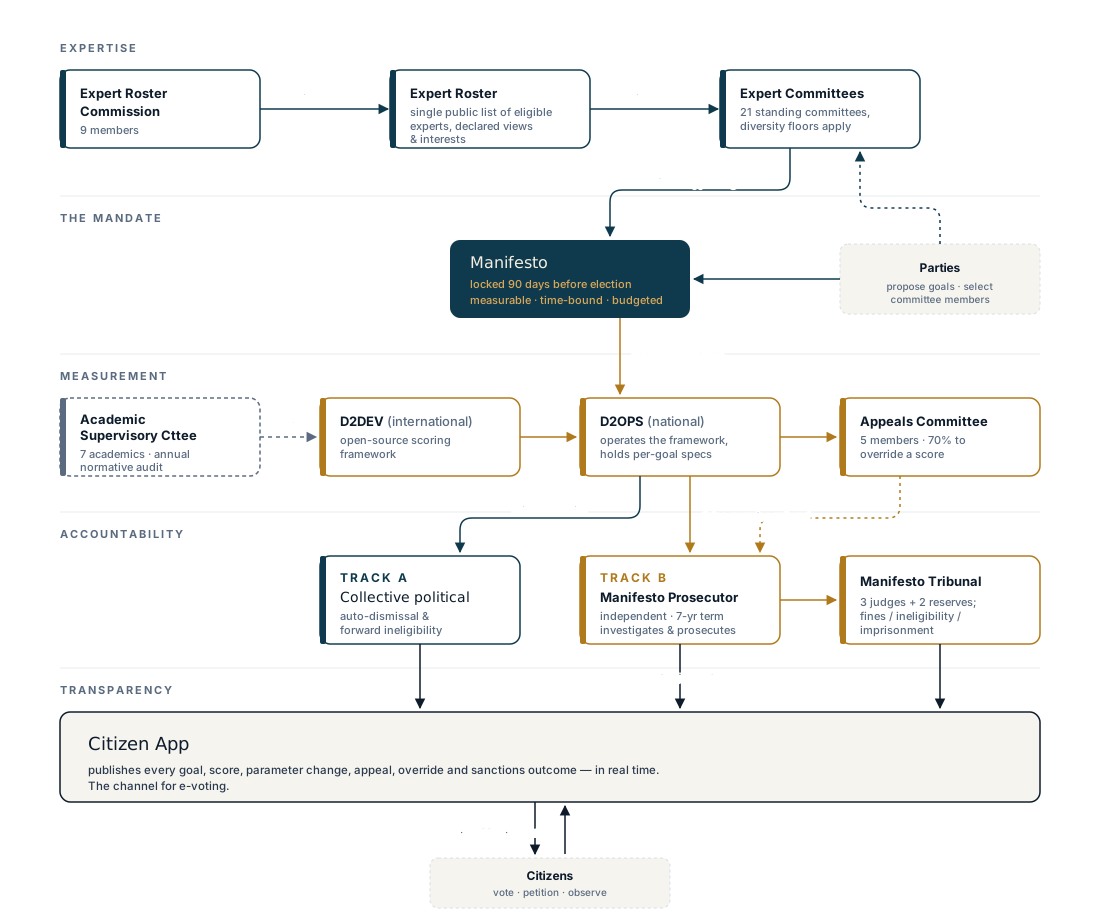
Measurement is the most consequential design choice in the system — and therefore the most heavily checked.
Illustrative mock-up. The Citizen App is described in §8 of the spec.
Political consequences for the government as a whole; adjudicative consequences for the individual politician who made a promise that should not have been made. They run in parallel.
Miss the milestones, lose the office. No individual fault required, no court involved — a clean ex-ante rule applied automatically.
Promises made outside the locked, expert-approved manifesto remain the principal source of cases. Brought by an independent prosecutor; tried as a civil-regulatory proceeding with full procedural protections. There is no custodial sanction — nobody goes to prison for a broken promise.
The system is designed to make promises stick. But a pandemic, a war, a natural disaster, a major economic shock can render previously-feasible goals materially unachievable. Change Management is the controlled, supermajority-gated exception — deliberately narrow, time-limited, and built so that "crisis" cannot become an indefinite excuse for suspending the rules.
Three concurrent conditions: a formal motion (by the government, 25% of parliament, or two or more affected expert committees); certification by each relevant expert committee that the event materially affects the named goals; and a 60% parliamentary supermajority. The motion must name the triggering event, the goals affected, the adjustment, and a duration — and is published in full on the Citizen App within 24 hours.
Only the goals enumerated in the motion are affected; everything else keeps scoring and carrying sanction risk as normal. For listed goals, scoring is frozen at "under §6 review" and the false-promise defence covers only promises rendered unachievable by the cited event — not unrelated misconduct. Crisis-response goals can be added quickly, but they are themselves scored and sanctionable from day one.
Initial duration is capped at six months. Every renewal requires a fresh motion at the full invocation threshold. If no renewal passes, the override lapses automatically and the goals revert to live scoring and full sanction risk. Promises made during the override stay protected by it; promises made after the lapse do not.
Three independent early-termination paths: a government motion (simple majority), a force-end petition by 40% of parliament (simple majority to pass — ending an override is deliberately easier than starting one), and a public recommendation by the Academic Supervisory Committee. Within 90 days of any end, the committee publishes a review of the invocation — including whether anyone's conduct warrants referral to the Manifesto Prosecutor.
The scoring system is the system's most powerful instrument and would be its most attractive target. Four cross-cutting safeguards apply at all times.
This site is a précis. The proposal exists at full length because the questions it raises deserve full-length answers. If you intend to engage substantively, read the spec.